
Effects of rust on fatigue
Rust pits raise local stresses allowing for cracks to start forming earlier, the corrosion also lowers fracture toughness. Crack initiation and propagation is generally increased.
Oxide-induced crack closure (OICC)
Whilst the adverse effects of corrosive environments and rust are well documented and intuitive, the opposite can also be true under the correct conditions. A fatigue crack can form a thin oxide / rust layer acting like a debris layer between the crack surfaces. During fatigue cycles the buildup of rust attenuate the impact by coming into sooner reducing the effective stress at the crack tip.
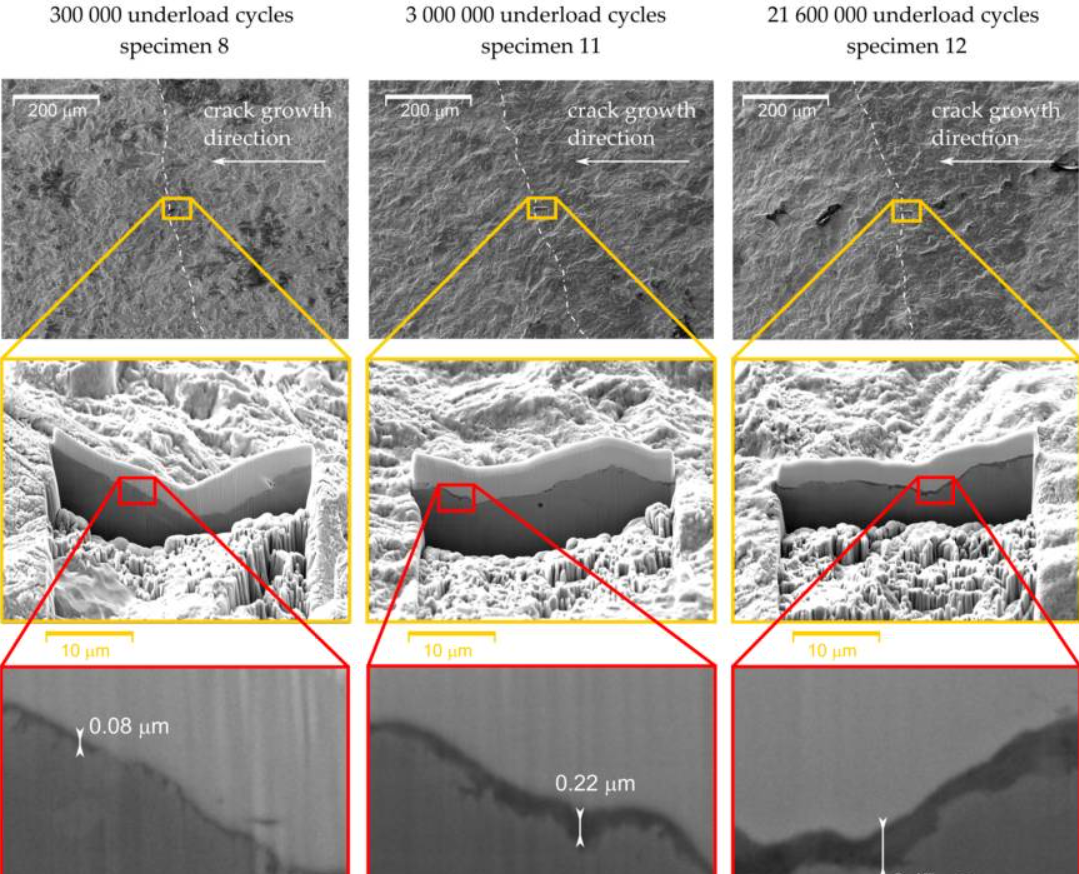 Image credit: Effect of Underload Cycles on Oxide-Induced Crack Closure Development in Cr-Mo Low-Alloy Steel
This figure documents how increasing numbers of underload cycles build up thicker oxide debris layers on the fracture surface, enhancing oxide‑induced crack closure and thus delaying crack‑growth.
The oxide layer width increased from 21 μm at 300,000 cycles to 319 μm at 21,600,000 cycles.