Computational Materials & FEA Portfolio
Applied energy-based damage and Hashin failure criteria in explicit FEA simulations to model fibre-reinforced composite fracture and damage evolution in static loading and machining.
Carbon Rod Machining Simulation
This explicit simulation demonstrates the cutting of a carbon fiber-reinforced composite rod using energy-based material deletion on the mesh. The element deletion models the material removal process during machining.
Explicit Gear Simulation
This simulation demonstrates a driver gear driving an entire geartrain using explicit FEA analysis. The dynamic contact interactions and stress distribution are modeled to understand the mechanical behavior of the gear assembly under operational conditions. Gears are rigid body and frictionless.
Lattice and Material Characterisation
Full methodology and results are detailed in the companion technical report: Additive Manufacturing and Topology Optimisation in Gearbox Design.
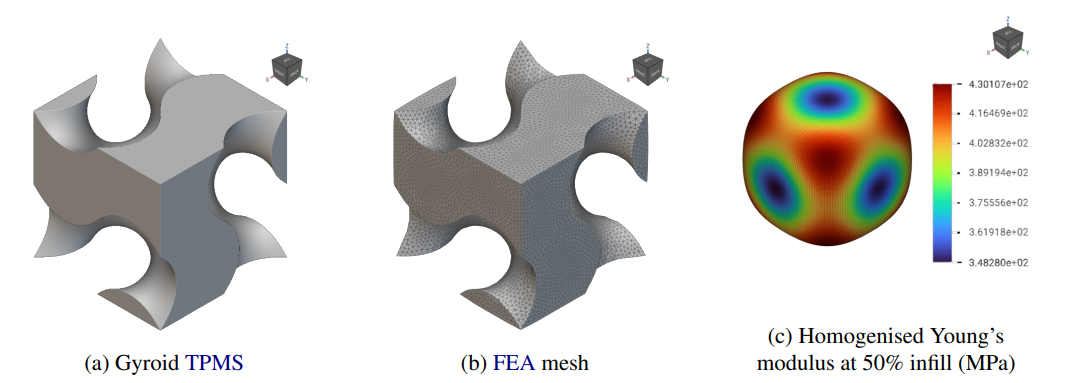
TPMS Lattice Material Studies
Exploratory work creating triply periodic minimal surface (TPMS) lattices in nTop and extracting homogenized properties for use in downstream FEA workflows.
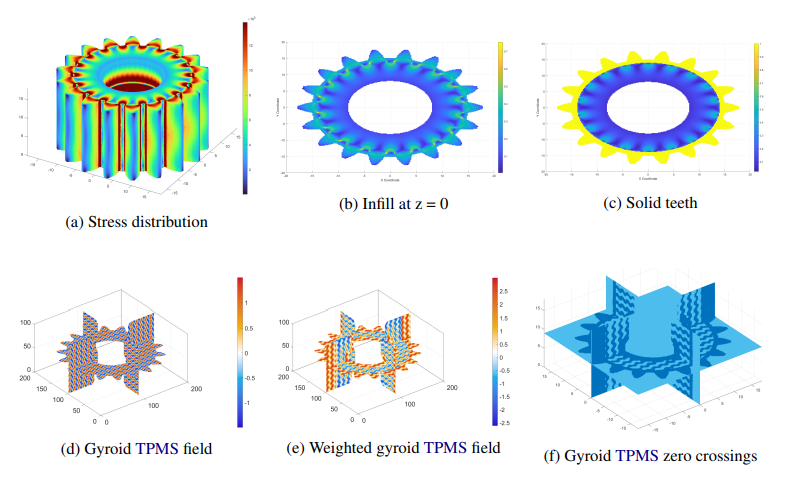
Stress-Driven TPMS Geometry
Created a TPMS unit cell guided by stress distribution fields, aligning lattice thickness with load paths to minimise mass while retaining stiffness in critical regions.
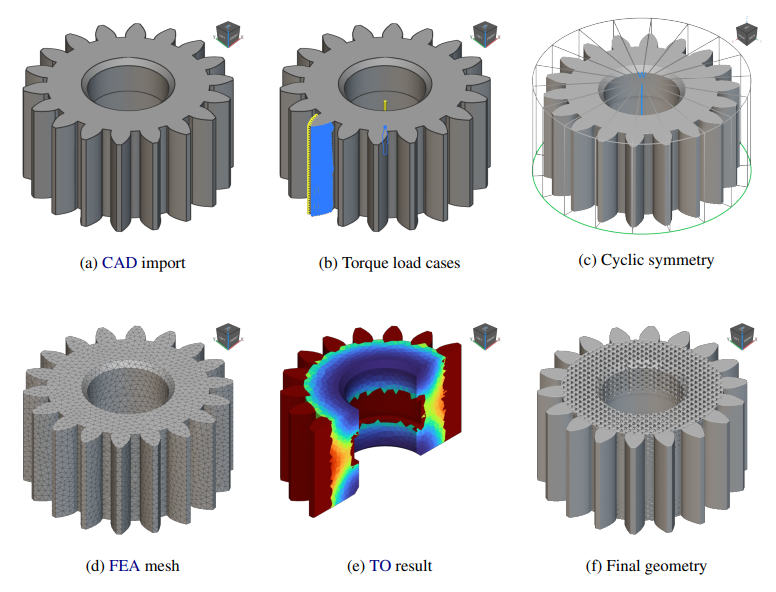
Topology-Optimized TPMS
Derived a TPMS lattice from a topology-optimized solid, translating density contours into periodic minimal surfaces to capture the same load-bearing intent in a manufacturable lattice.
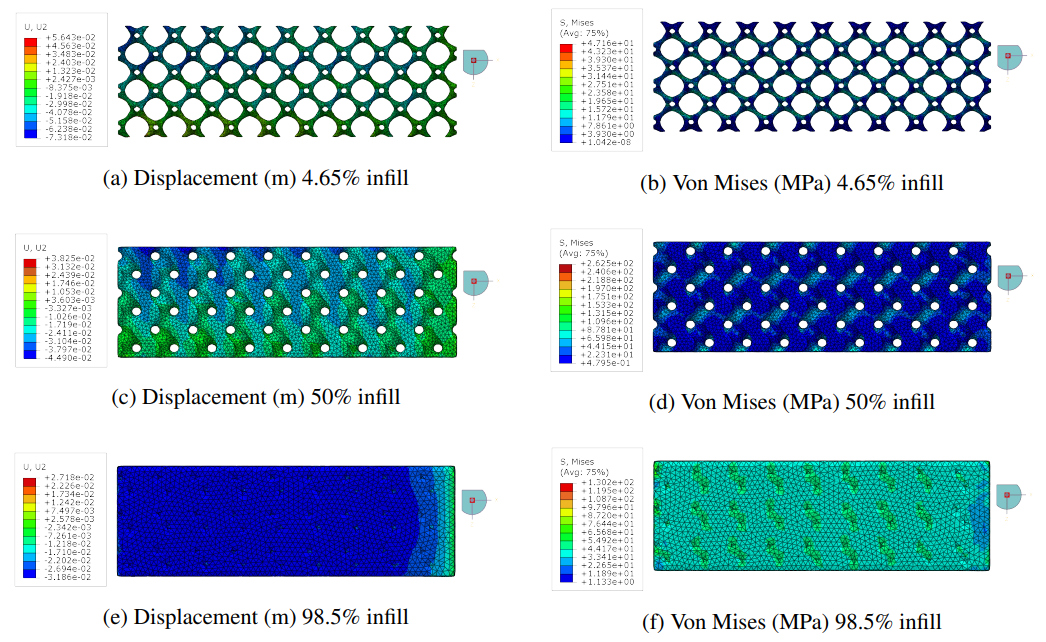
Homogenization Workflow
Built a homogenization pipeline to extract equivalent orthotropic properties from TPMS samples, enabling reduced-order lattice representation in macro-scale FEA models.
Homogenized Property Field
Applied the homogenized material tensors back into nTop to visualize spatially varying stiffness and validate consistency with the detailed lattice response.